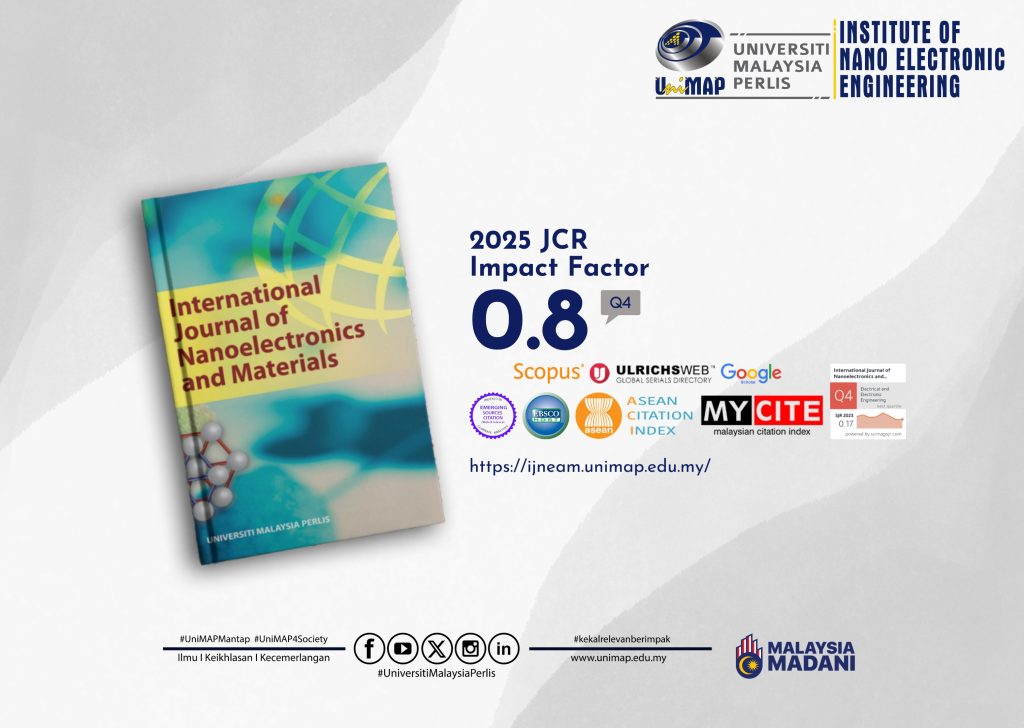
Congratulations to IJNeaM on the success of achieving a JCR IF of 0.8. Keep up the success.
Institut Kejuruteraan Nano Elektronik
Universiti Malaysia Perlis
Congratulations to IJNeaM on the success of achieving a JCR IF of 0.8. Keep up the success.
Abstract – Scope: Foam cell formation is a hallmark of early atherosclerosis, driving plaque development and chronic vascular inflammation. These lipid-engorged macrophages form through excessive uptake of oxidised low-density lipoprotein (oxLDL) and play a central role in disease progression. Graphene nanoplatelets (GNPs), known for their high surface area and biocompatibility, have emerged as promising nanomaterials for biomedical intervention. This study evaluates the potential of GNPs to prevent atherosclerosis by targeting foam cell formation. Methods: Computational analyses, including molecular docking and dynamics simulations, were used to assess the binding affinity of GNPs with key atherogenic proteins such as apolipoprotein B and the LDL receptor. GNPs were structurally characterised using Raman spectroscopy, X-ray diffraction, and Fourier-transform infrared spectroscopy. In vitro assays were conducted on RAW264.7 macrophages to assess cytotoxicity, lipid accumulation, cholesterol levels, cytokine production, and gene expression after treatment with GNPs (1 μg/mL) and oxLDL. Results: GNPs exhibited strong binding affinity to apoB and the LDL receptor, suggesting potential interference with lipid uptake. Structural analyses confirmed the integrity and purity of the GNPs. In vitro, GNPs showed no cytotoxic effects and significantly reduced lipid accumulation and intracellular cholesterol levels in oxLDL-treated macrophages. They also suppressed the secretion of pro-inflammatory cytokines (IFNγ, IL-6, IL-1β) and downregulated genes associated with foam cell formation (IL-1β, ACAT-1, CD36), while upregulating ABCA1, a key gene involved in cholesterol efflux. Conclusion: These findings demonstrate that GNPs effectively inhibit foam cell formation, reduce atherogenic inflammation, and enhance lipid clearance in macrophages. GNPs represent a promising nanotherapeutic strategy for the prevention of atherosclerosis.
Author: Assoc. Prof. Ir. Ts. Dr. Muhammad Mahyiddin Ramli
Author’s Email: mmahyiddin@unimap.edu.my
Download: PDF
Link to Publication: https://link.springer.com/article/10.1007/s12195-026-00899-w